
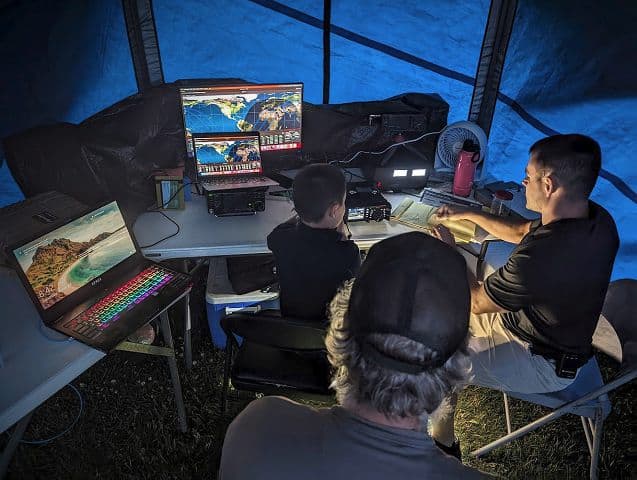
MCARC at ARRL Field Day
Each June, amateur radio operators across North America leave the comfort of their home stations and take their equipment into parks, fields, campgrounds, emergency operations centers, and other temporary locations. For 24 hours, they build antennas, set up radios, generate their own electrical power, and attempt to contact as many other stations as possible.
This annual event is called ARRL Field Day.
Field Day is part operating event, part emergency communications exercise, part technical challenge, and part public demonstration of amateur radio. It gives radio operators an opportunity to practice setting up a complete communications station under conditions very different from those at home.
In a real emergency, normal communications systems may be overloaded, damaged, or unavailable. Amateur radio operators can establish independent stations using portable antennas, generators, batteries, and equipment that can communicate over local, regional, national, and even international distances. Field Day provides an enjoyable way to practice those skills before they are needed.
It is also one of the best opportunities to see amateur radio in action.
Visitors can watch operators contact stations hundreds or thousands of miles away using voice, Morse code, and digital signals. Newer hams can gain operating experience alongside experienced club members. Those who are curious about amateur radio can see that the hobby includes much more than talking into a microphone. It combines electronics, antennas, computers, geography, communication skills, public service, and friendly competition.
The MCARC Field Day Station
The Medina County Amateur Radio Club, operating under the club call sign W8EOC, holds its Field Day operation at Mill Stream Park in Valley City, Ohio.
Our Field Day station operates in the 5A category. The “5” means that we operate five simultaneous primary transmitting stations, while the “A” identifies us as a club or group operating from a temporary field location.
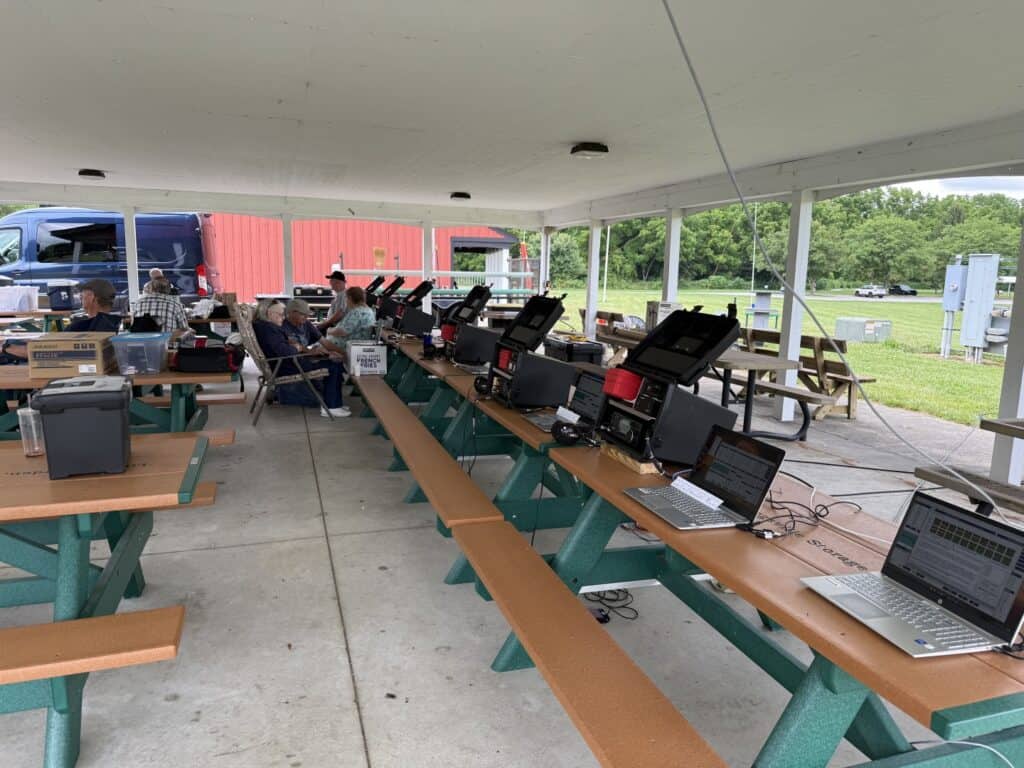
Across the large field, club members erect five portable 45-foot masts, spaced well apart to reduce interference between stations. Each mast supports a multiband fan dipole antenna system covering across the shortwave spectrum at 80, 40, 20, `5, and 10 meter ham bands as the propagation allows.
A fan dipole consists of several dipole antennas connected to a common feed point, with each pair of wires cut for a different amateur radio band. The wires spread outward from the mast in different directions, giving the structure its fan-like appearance. In our installation, the antennas also help support the portable masts.
In addition to the five main stations, MCARC operates a separate station on the 6-meter band, often called “the magic band” because propagation conditions can change suddenly and allow surprisingly long-distance contacts.
CW, Voice, and Digital Communications
MCARC uses several different operating modes during Field Day.
CW, commonly known as Morse code, remains one of the most effective ways to communicate under weak-signal and crowded-band conditions. Skilled CW operators can often complete contacts that would be difficult or impossible using voice.
SSB, or single-sideband voice, allows operators to speak directly with other Field Day stations. It is usually the most familiar and immediately understandable mode for visitors listening to amateur radio for the first time.
FT8 is a computer-assisted digital mode designed to exchange information using signals that may be too weak to hear by ear. The computer helps decode the signal, but the operator still selects stations, manages the radio, and completes each contact.
Together, these modes demonstrate the remarkable variety of ways information can be sent over the air.
A Club-Wide Effort
Field Day begins long before the first radio contact is made.
Fred Helwig, K8FH, is responsible for putting together the club’s Field Day hardware, having honed the setup and operation over the last ten years or so. He has it all packed on a large trailer that he rolls up to the site. He is also often the top CW scorer most years.
Members plan the station layout, inspect equipment, prepare antennas and feedlines, arrange emergency power, organize food and shelter, and determine how the stations will operate without interfering with one another. On the morning of the event, the empty field gradually becomes a temporary communications site filled with masts, wires, tents, radios, computers, generators, and operators.
Once operation begins, the stations remain active throughout the afternoon, evening, overnight hours, and following morning. Some bands are most productive during daylight, while others become active after sunset. Operators rotate through the stations while other volunteers handle logging, repairs, meals, safety, and technical support.
At the end of the event, everything must come down again. Within a few hours, the temporary station disappears and the park returns to an open field.
Come See Amateur Radio in Action
Field Day is open to visitors, and no amateur radio license is required to stop by.
Whether you are an experienced operator, a newly licensed ham, someone considering getting a license, or simply curious about the antennas rising above the field, you are welcome to visit the Medina County Amateur Radio Club’s Field Day operation.
You can meet club members, see the stations, learn how the antennas work, listen to contacts being made across the country, and discover the many technical, recreational, and public-service activities available through amateur radio.
Field Day shows what can be accomplished when people combine practical skills, experimentation, teamwork, and a willingness to communicate.
For one weekend each year, Mill Stream Park becomes one of thousands of temporary radio stations connecting communities across North America—and beyond.